TVET Training Lab Turning Knowledge Into Capability - Top Manufacturers in India
If education builds understanding, training builds capability. Training is the teaching or development of skills, knowledge and competencies tied to specific, useful tasks — and its goals are practical and measurable: to improve a person's capacity, productivity and performance. Where education often asks "why?", training asks "how?", and it answers that question through repetition, demonstration, supervised practice and real equipment in real working conditions.
Training sits at the heart of how societies prepare people for work. It forms the core of apprenticeships and provides the backbone of the content taught at institutes of technology, technical colleges and polytechnics. And it does not stop once a person becomes competent. Throughout a working life, training continues — maintaining, upgrading and updating skills as tools, methods and technologies change. In many professions this ongoing process is called professional development, and it is one of the great engines of demand for vocational and technical education worldwide.
Why training cannot be taught from a textbook alone
You cannot learn to weld by reading about welding. You cannot master a hydraulic system, calibrate a control loop or run a materials test purely from a diagram. Training, by its nature, demands doing — and doing demands the right working equipment. This is the single most important fact about technical and vocational education: its quality is bounded by the quality of the equipment learners can actually put their hands on.
A trainee mechanic needs automobile engineering lab equipment to understand how engines, transmissions and modern autotronics systems behave. A future civil engineer needs civil engineering lab equipment — soil testing equipment, cement and bitumen testing equipment, concrete lab testing and compression testing machines, aggregate testing apparatus and survey equipment — to learn how the materials of the built world actually perform. A mechanical engineering student needs working rigs for fluid mechanics, heat transfer, theory of machines and thermodynamics, because these subjects only truly make sense when measured, observed and repeated.
This is the territory where engineering lab equipment becomes the curriculum, not just a support for it. The bench, the trainer kit and the testing machine are where competence is forged.
The rise of the trainer kit
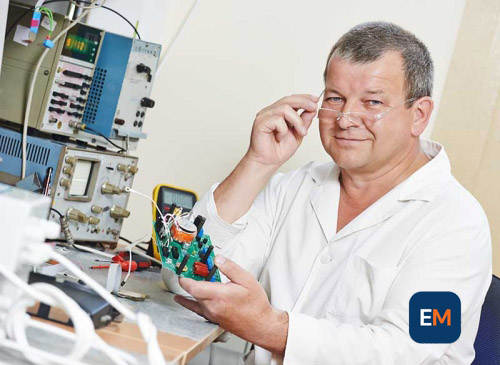
Modern technical training has been transformed by the development of dedicated educational lab trainer kits — self-contained, safe, instructional systems that compress a whole field of study into a teachable, repeatable platform. Analog and digital electronics trainer kits, breadboard trainers, communication and consumer electronics trainers, power electronics trainer kits, instrumentation trainers, fiber optic trainers, microwave test benches, robotic kits and embedded microprocessor lab equipment all share a common purpose: to let a learner explore complex systems hands-on, without danger and without the cost or risk of full industrial gear.
These trainers matter because they bridge theory and practice. A student who has built a circuit on a trainer, traced a fault on a communication system, or programmed a robotic kit arrives at the workplace already familiar with the logic of the real thing. For institutions, well-chosen trainer kits multiply teaching capacity — one instructor can guide many learners through structured, identical experiments. For training authorities writing procurement specifications, these kits are frequently the centrepiece of a vocational equipment tender.
Testing, measurement and the discipline of accuracy
A defining feature of good training is that it teaches people to trust measurement over assumption. This is why testing lab equipment is so central to technical education. Material testing lab equipment, universal testing machines, Rockwell hardness testers and the broader family of strength-of-material and site-investigation apparatus do more than produce numbers — they instil a professional mindset. A trainee learns that a material either meets the standard or it does not, that a result must be repeatable, and that careful procedure is not bureaucracy but the foundation of safe, reliable work.
This discipline carries directly into industry. The engineer who learned on a properly calibrated testing machine becomes the engineer who insists on proper testing on site. In this sense, the equipment in a training laboratory does not just teach a skill; it shapes a culture of quality that follows graduates into their careers.
Training as a driver of public tenders
Because skilled workforces are so closely tied to economic development, governments invest heavily in vocational and technical training — and that investment, like investment in schools, flows largely through structured public procurement. Ministries, technical education authorities, skills-development agencies and donor-funded programmes regularly issue tenders, bids, RFPs, RFQs and ICBs to equip technical colleges, polytechnics and vocational training centres.
These tenders are demanding. A single project might call for a complete refrigeration and air-conditioning lab, a fluid machines lab, a strength-of-materials lab, a process control or mechatronics lab, and the trainer kits to support an entire electronics curriculum — all delivered together, to specification, with documentation and after-sales support. Fulfilling such a contract requires a manufacturer who can supply across the full breadth of technical education equipment and stand behind it.
Educational-Mart is built for exactly this work. We manufacture and export the engineering and technical education equipment that vocational tenders specify — from mechanical, civil, automobile and electrical engineering lab equipment to electronics trainer kits, testing machines and complete vocational training labs — supported by export-ready documentation, secure packaging and worldwide logistics. For the contractors, consultants and institutions pursuing technical and vocational training tenders, bids and government contracts, that breadth and reliability turn a complex multi-lab project into a single, dependable supply relationship.
Equipping the whole pipeline
One of the strengths of a well-planned training programme is coherence. A polytechnic does not need isolated pieces of apparatus; it needs labs that work together to carry a student from first principles to advanced practice. A thoughtful equipment partner helps design that pipeline — pairing applied mechanics equipment with theory-of-machines rigs, linking fluid mechanics labs to heat-transfer and thermodynamics stations, and connecting electronics trainers to communication and control-system benches.
When equipment is specified and supplied as a coherent whole, training becomes smoother and outcomes improve. Instructors spend less time improvising around equipment gaps and more time teaching. Learners experience a logical progression rather than a patchwork. And procurement teams achieve better value, because the labs they fund actually deliver the curriculum they were meant to support.
The lasting return on training
Of all public investments, training is among the most durable. A new road eventually wears out; a trained electrician, technician or engineer keeps creating value for decades, and often trains others in turn. The equipment that makes that training possible — the trainer kits, the testing machines, the engineering labs — is therefore not an expense but a multiplier, turning a one-time purchase into a lifetime of capability.
That is the spirit in which we approach every vocational and technical project. Whether the goal is a single trainer kit for a small institute or the full equipping of a national network of technical colleges through a major tender, the mission is the same: to give learners the genuine, hands-on tools they need to turn knowledge into real, working skill.
Educational-Mart is an ISO 9001-certified manufacturer and exporter of engineering, technical and vocational training equipment, supplying technical colleges, polytechnics and government training tenders across 60+ countries. For tender enquiries, RFPs and RFQs, contact our team.